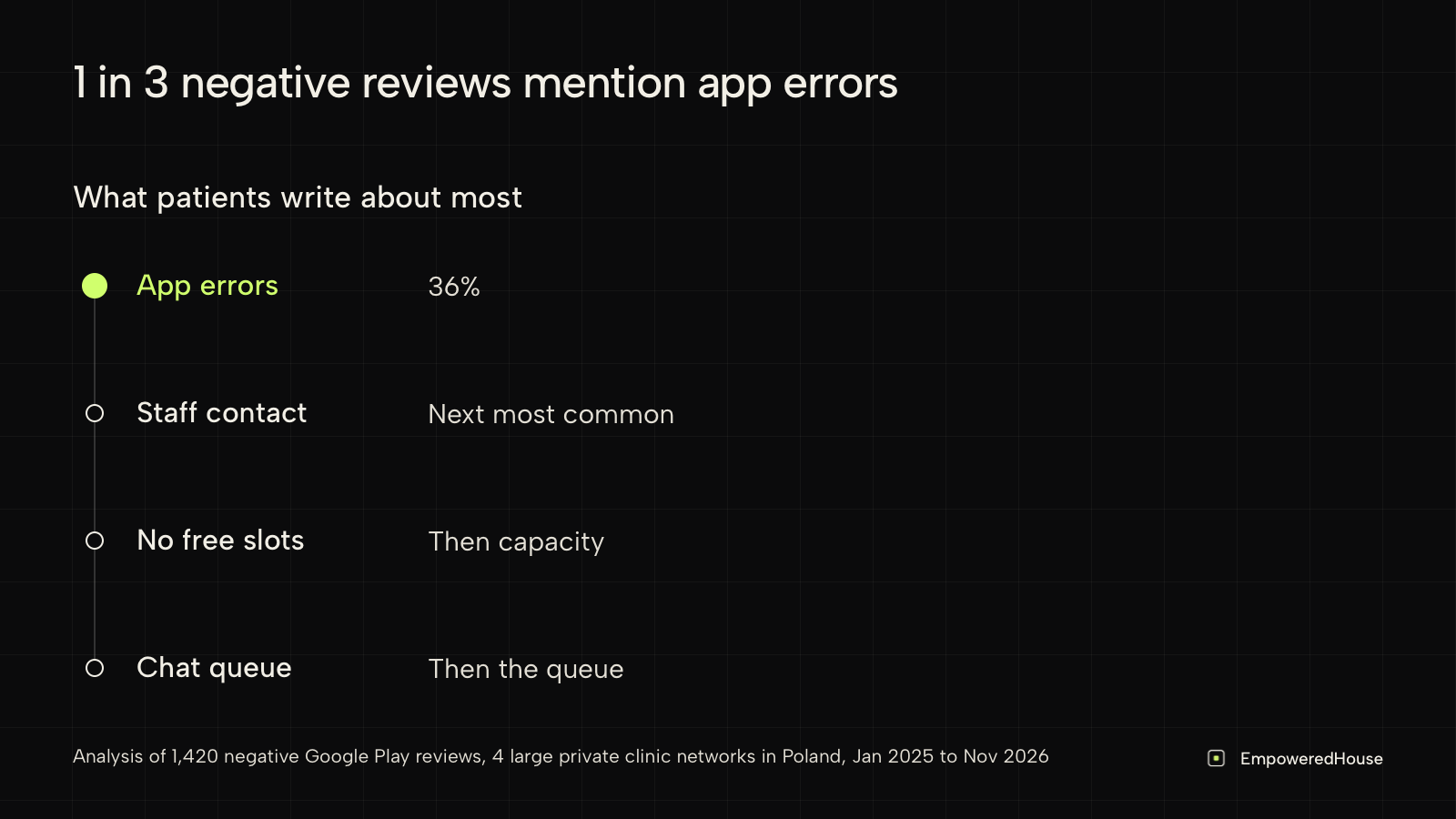
Private clinic app complaints most often mention the app itself: in our analysis of 1,420 low-rated Google Play reviews from 2025 and 2026, app errors were the most frequently tagged theme, at about 36%. Difficulty reaching staff came next, at about 28%, and difficulty finding appointments at about 17%.
The star average and the written reviews disagree. In 2 of the 4 apps, the Google Play average is above 4.6, yet 61 to 64% of their written reviews from 2025 and 2026 give 1 or 2 stars. The 2 measures cover different groups of users, so a clinic owner should read both.
This is our own exploratory analysis of public app reviews, not a patient survey: 1,420 low-rated reviews out of 2,182 with text, from the patient apps of 4 large private clinic networks in Poland, 1 January 2025 to 8 November 2026. How we counted is at the end of the article.
Why should a private clinic owner read app reviews?
Because access to care is a recurring problem for Polish patients. Poland's Patient Ombudsman received 96,244 enquiries and complaints in 2025. Its report names access to healthcare services as a recurring problem and notes similar difficulties in privately funded care, including medical subscriptions¹. These figures cover Polish healthcare as a whole; they include no separate count for private clinic apps.
In a June 2025 CBOS survey, 36% of adults in Poland reported additional health cover, such as a subscription or a policy². Private clinic networks offer those patients booking through their own apps, and reviews show where that booking went wrong.
What are the most common private clinic app complaints?
The 5 most frequently tagged themes in the 1,420 low-rated reviews, from the most common (shares are in the table below; a review can carry more than 1 tag):
- App errors: crashes, login loops, forced logouts and updates that remove features.
- Cannot reach staff: the helpline, reception or chat does not answer.
- Difficulty finding appointments: distant dates, no free dates or no doctor listed.
- Chat and e-consultation: reported waits, dropped sessions or a lost place in line.
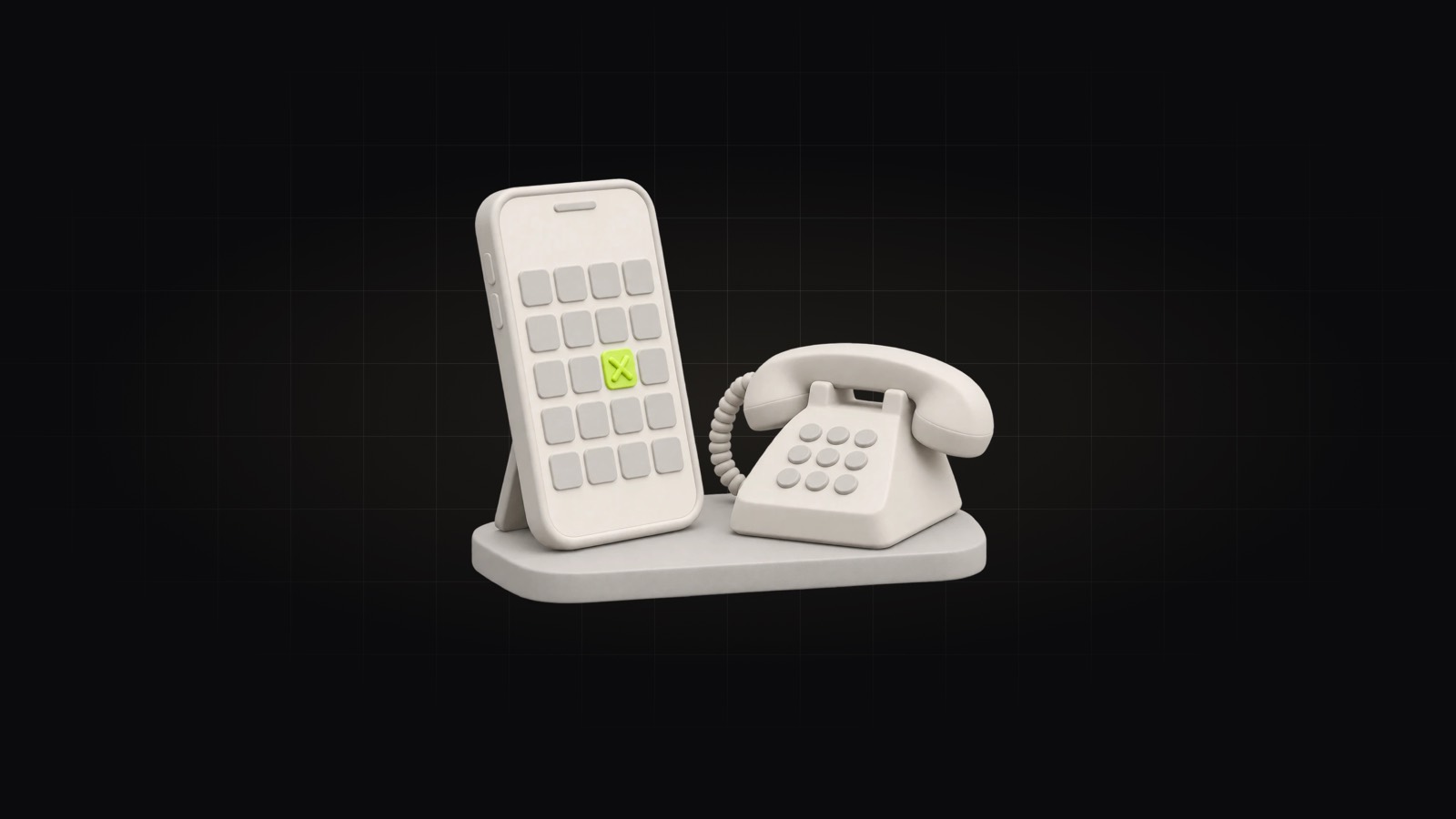
- "I have to phone, the app won't let me."
Examples of booking and consultation problems reported in the reviews, paraphrased:
- The app shows no free dates. You call the helpline. The helpline finds a date for the same doctor.
- You wait close to an hour for an online consultation. You attach a file in the chat. The chat closes, and you are out.
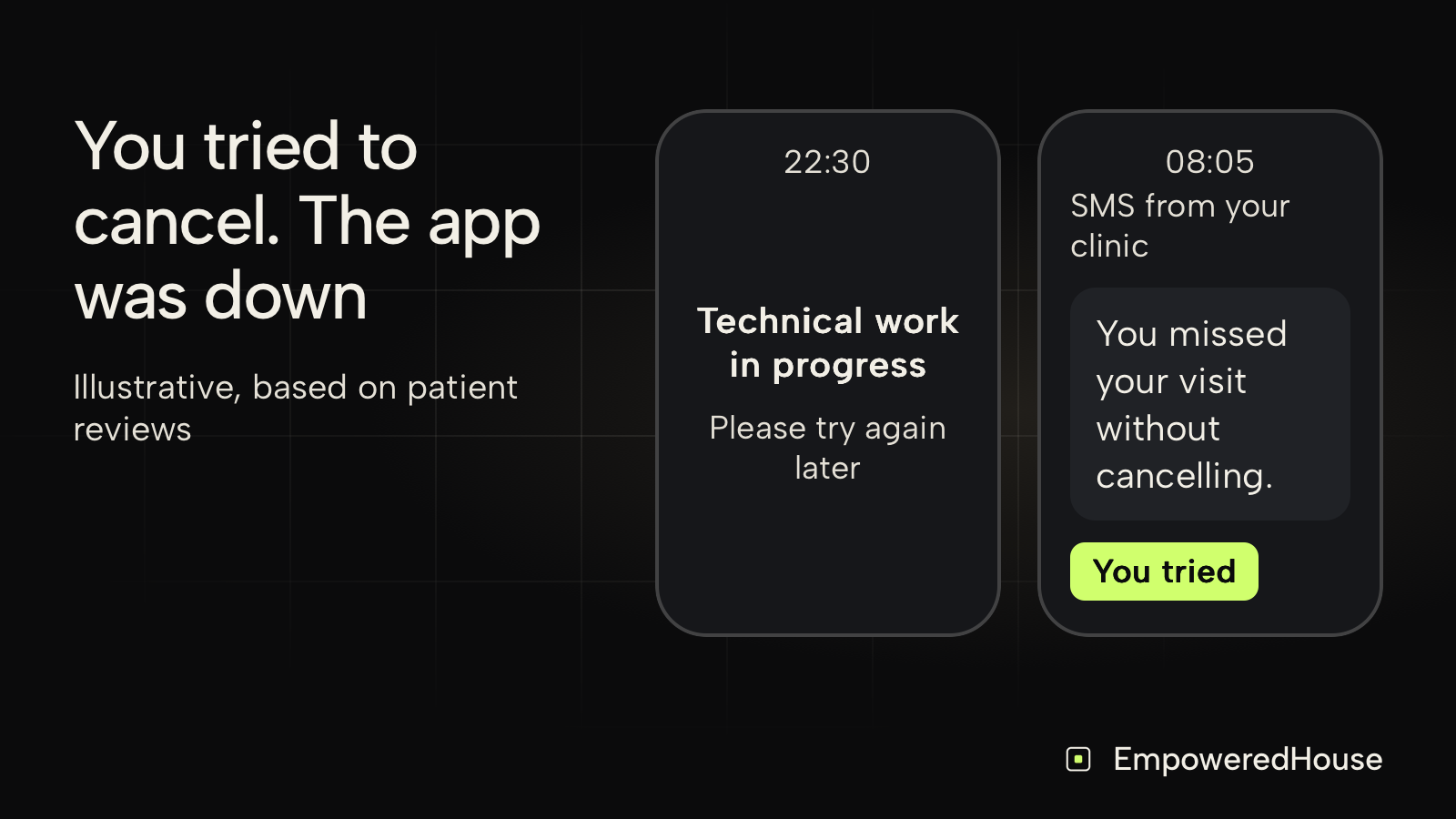
- You try to cancel a visit late in the evening. The app says technical work is under way. Later you receive a message about a missed visit.
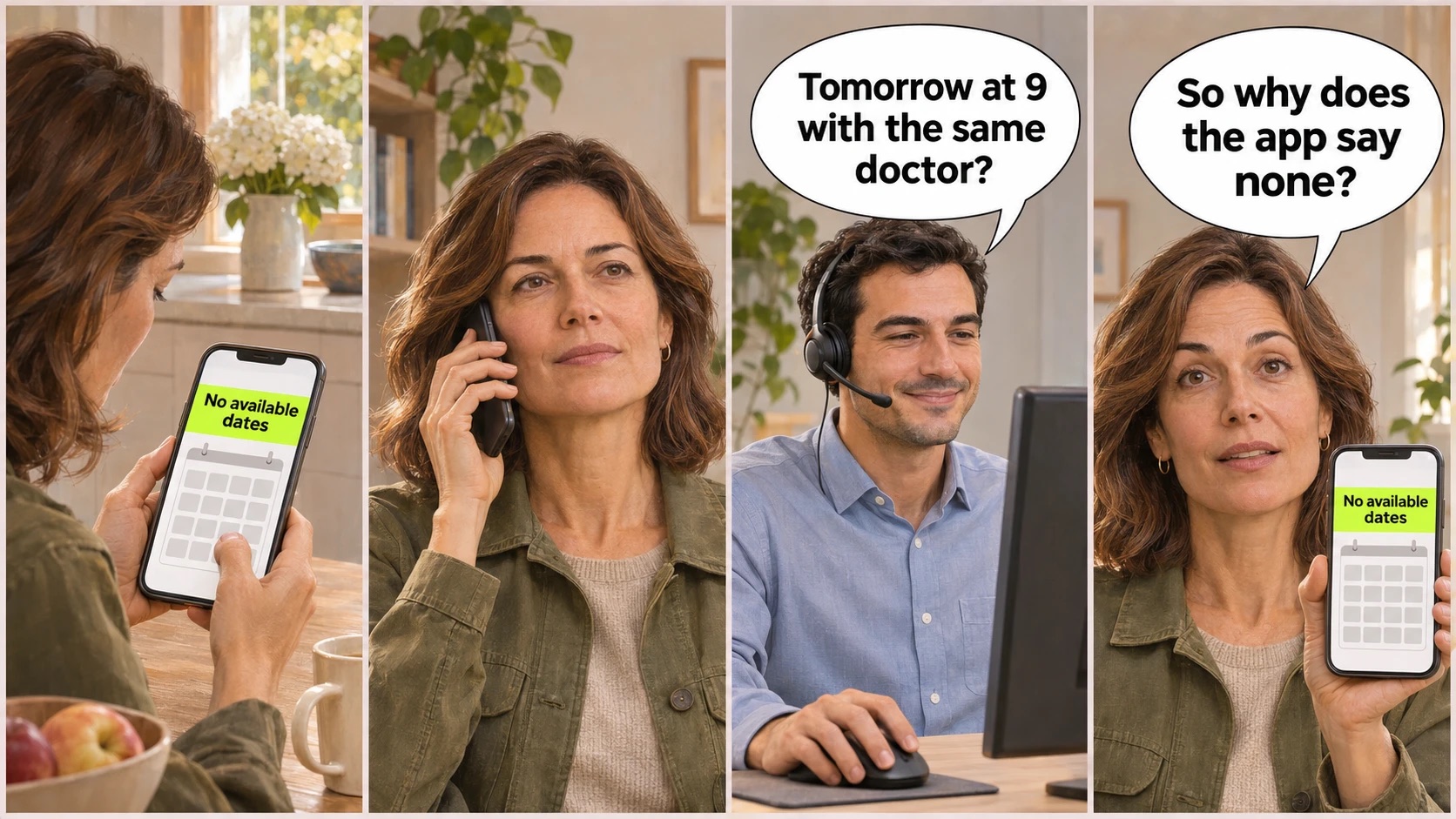
AI-generated illustration of a scenario based on review themes; not a record of a specific case.
Other reported situations, paraphrased:
- there are no slots under the subscription, but the same visit is open for a one-off fee;
- the system will not book a specialist without a prior visit to a GP.
Which complaints could software address, and which may be about capacity?
The table separates the reported symptom from its likely type of cause. The cause is our judgement, to be checked against a clinic's own logs and booking rules before any decision.
| Theme | Share of 1,420 | Likely type of cause | Could software help? |
|---|---|---|---|
| App errors, logins, updates | about 36% | software | Likely, if logs confirm it: crash and login logs, updates tested before they ship |
| Cannot reach staff | about 28% | mixed | Partly: fewer reasons to call; staffing stays |
| Difficulty finding appointments | about 17% | capacity or booking rules | Only where free dates exist but cannot be booked; check real capacity first |
| Chat queue drops the patient | about 14% | software and capacity | Partly: the queue can keep a place; the wait for a doctor stays |
| Must phone the helpline | about 9% | software or booking rules | Possibly: the same booking rules in the app and on the phone, where policy allows |
| Package limits, surcharges | about 8% | contract rules and communication | Partly: show what the package covers before booking |
| Payments, refunds, invoices | about 8% | software or partners | Possibly, if the fault sits in the app |
| Prescriptions, results, sick notes | about 8% | mixed | Partly: visible once issued; a doctor's delay stays |
| Slot visible but not bookable | about 6% | software and rules | Yes, where the rule allows |
| Cancel or reschedule | about 3% | software or rules | Possibly, within the clinic's cancellation policy |
| Referrals | about 3% | process rules | Partly, where medical rules allow |
Tags record what patients wrote; the cause still needs checking. Even so, app errors, the most frequently tagged theme, are the one the table marks as a likely software cause.
Why might a clinic app send patients to the phone?
Our hypothesis: an off-the-shelf system is built for many clinics at once, so the rules of a specific network live outside it. Packages, visit limits, several payers, equipment that must be free, the GP-first rule for specialists: when the system cannot hold a rule, a person holds it. The patient then has to reach that person, which means the helpline.
The pattern "the app shows nothing, the helpline finds a slot" fits this reading, though other causes are possible: separate booking pools, eligibility rules, a delay in syncing availability or a technical fault. In that reading, the rule that decides who may book the slot sits with staff.
We have not proven this: the reviews do not show who built each app or how.
Our separate build report on clinic management software built on a clinic's own rules, about a different clinic, looks at the same problem from the other side: reception staff working around rules their system could not hold, and the time and trust those workarounds cost.
What could a clinic's own app change, theme by theme?
With EHOS, a process that makes your company different can get its own app, built from how your team works. Rules and deadlines are kept by the system, so they don't depend on someone remembering; the system refuses steps nobody agreed to. Applied to the complaints above, that could look like this. The examples are illustrative, and a first step would be 1 process that does not touch patient data, such as the visit schedule rules.
- The same slots everywhere. For example, a slot appears only when a doctor and the needed equipment are both free, and every channel reads the same rule. That targets the "I have to phone" theme and the visible-but-not-bookable slot.
- Package limits before booking. The app could show what the package covers before the patient picks a date, so the visit does not turn "paid" at the end.
- Cancellation by the clinic's own rules. Cancelling and any fee could follow rules kept in the system, and a freed slot could go straight back to the calendar.
- Pricing rules in the system. For example, a visit split between a package and a surcharge can be priced by rules kept in the system, the same way at every desk.
- Referrals that lead to booking. A referral could open the booking for the test, where the medical rule allows it.
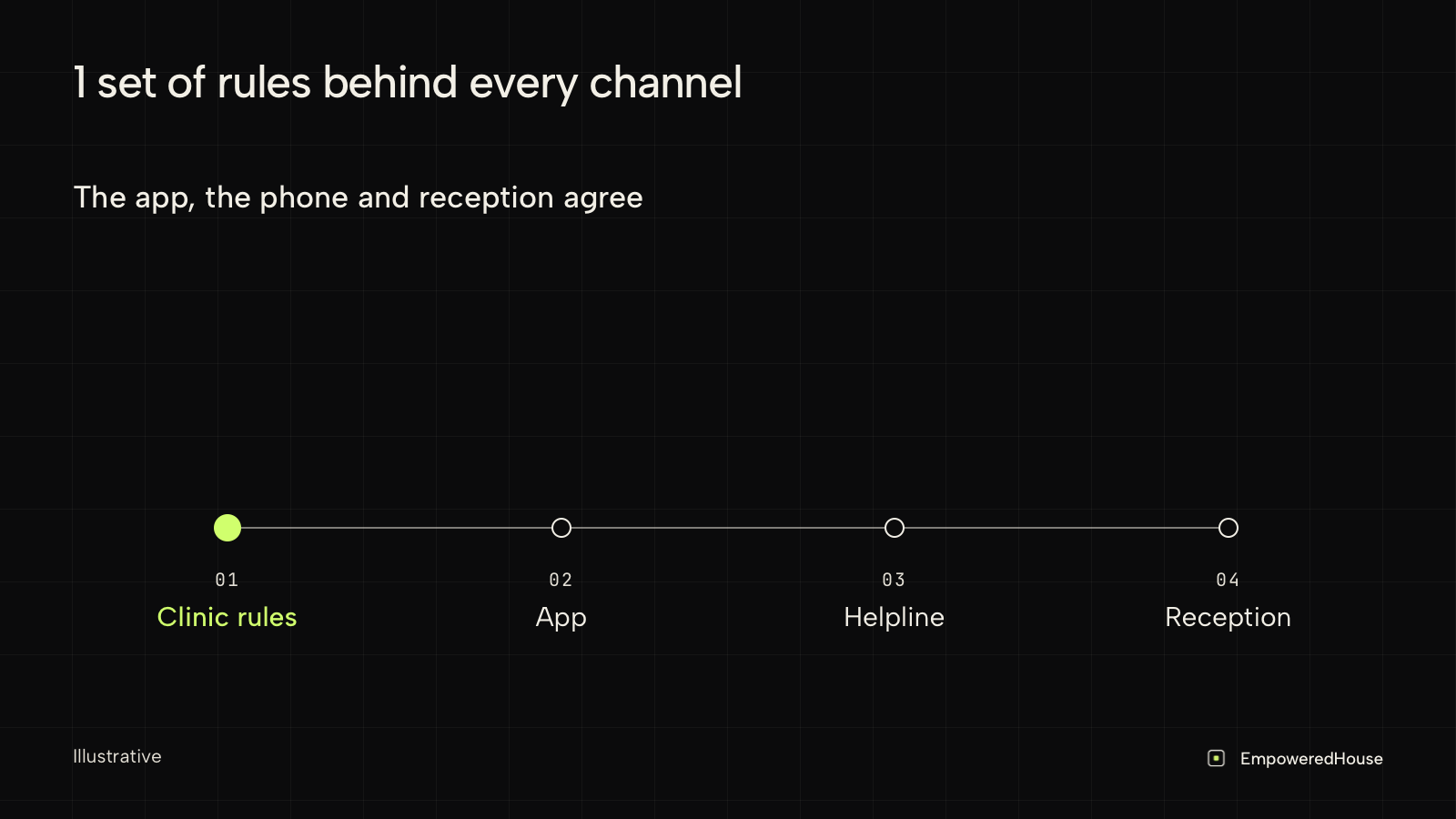
You can see who did what and when, so a changed booking or a refund leaves a trail. Each next app starts with access rules and an audit trail already in place, so a reception app and a patient app could share 1 set of rules.
This is work in progress: ideas we are exploring and testing in our clinic build. The early experiments look promising, and we test each idea on 1 process at a time.
What can't software fix in a private clinic?
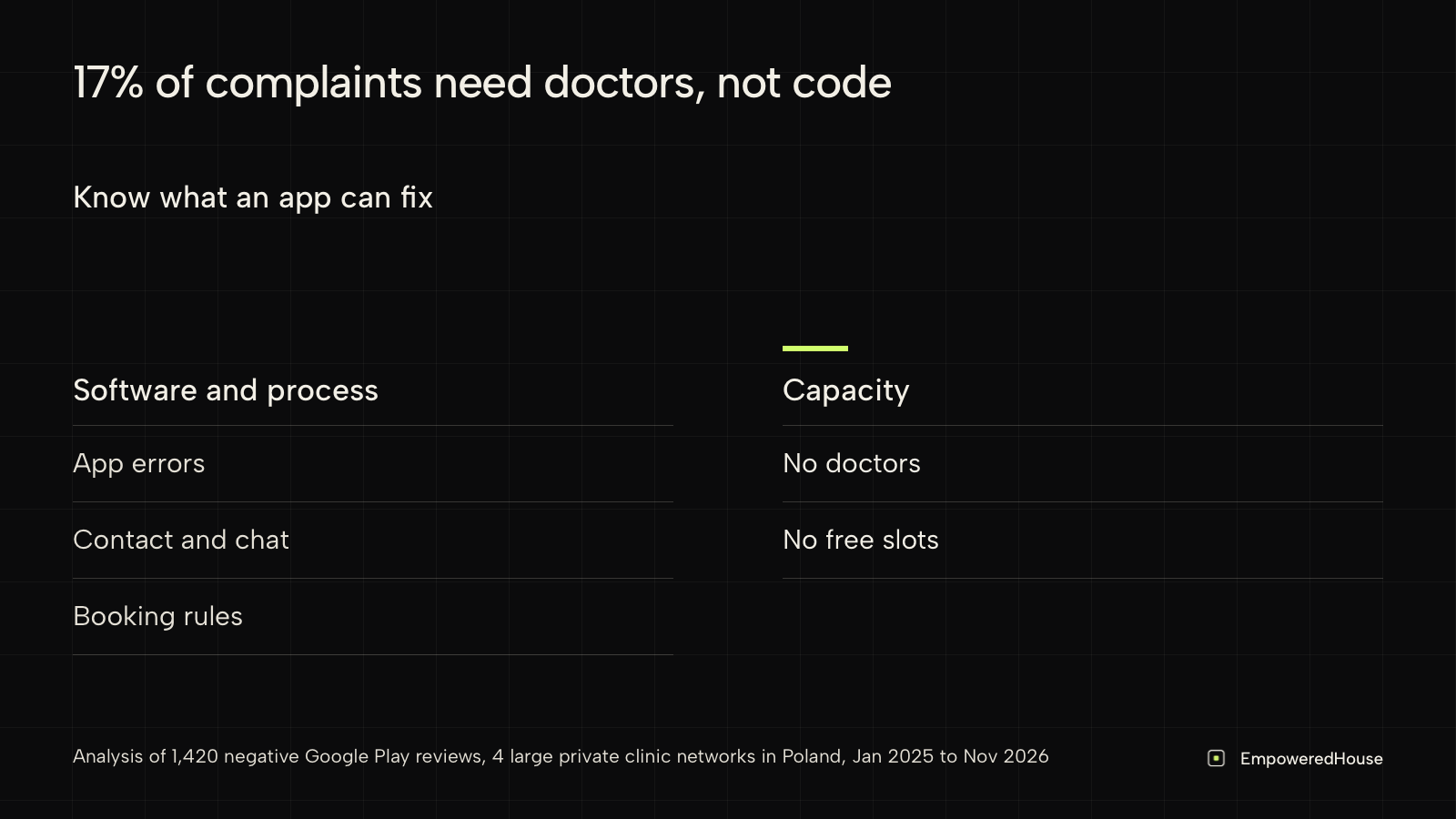
Some complaints need more doctors, and code will not add them.
- Too few doctors and dates. Where the cause behind reviews about difficulty finding appointments is a real shortage, an app can show free dates honestly. It cannot create them.
- The wait for a doctor in chat. A queue can keep a patient's place after a logout. If too few doctors are on duty, the wait stays.
- Policy decisions. Fewer slots for subscribers than for patients paying per visit is a business decision. Software can at most make the rule visible.
If your reviews are mostly about missing doctors, an app project will change little. If they are about logins and surprise charges, the software and its rules are the place to look.
FAQ
What are the most common private clinic app complaints?
In our analysis, app errors were the most frequently tagged theme, at about 36% of the 1,420 low-rated reviews, followed by difficulty reaching staff (about 28%). A review could carry more than 1 tag.
Why does the app show no appointments when the helpline has them?
Different booking pools, eligibility rules, delays in syncing availability or a technical fault can all produce this. Compare the same booking request in both channels before deciding what to change.
Why is my visit shown as paid when I have a medical package?
The package covers a set list of services and limits. When the app does not show those limits before booking, a covered-looking visit can turn paid at checkout.
Are app store ratings a good measure of patient satisfaction?
They are 1 signal. Google Play weights its displayed rating towards recent ratings, and written reviews are self-selected, so neither shows how many patients are dissatisfied.
Can a better clinic app fix doctor shortages?
It cannot add clinician hours. It may help patients use free dates that exist but are hard to book, so check first whether the problem is a real shortage.
When does a private clinic need its own app?
When a recurring, verified problem cannot be solved through the current system's settings or integrations, and staff fill the gap by phone.
Pick the 1 booking or reception task that still ends with someone on the phone. We will look at it with you and tell you whether software can reach it. Talk to us about EHOS.
Prepared by the Empowered House team; more about us.
How did we analyse 1,420 clinic app reviews?
- Source: Google Play, Polish store, the patient apps of 4 large private clinic networks in Poland; network names are withheld.
- Period: 1 January 2025 to 8 November 2026.
- Selection: the 2,182 written reviews we collected for that period. Of these, 1,420 gave 1 or 2 stars and were longer than 15 characters. Those 1,420 are the sample.
- Coding: our team tagged each review with Polish keywords for 11 non-exclusive themes. A tag records what a review mentions. 1 review can carry several themes, so the shares add up to more than 100%.
- Accuracy: we checked a sample by hand and found that some keywords catch more than intended; for example, the keyword for "queue" also catches the queue for chat. Read every share as an estimate.
- Privacy: we show no author names, personal data or network names, and we paraphrase reviews rather than quote them.
Limits. Written reviews are self-selected and cover Android users only, and some apps have many more reviews than others. So the analysis shows what dissatisfied reviewers repeat. It does not show how many patients are dissatisfied.
Sources
- Rzecznik Praw Pacjenta (Patient Ombudsman), report on activity in 2025, approved version published 13 November 2026 (pages 14 and 38): gov.pl
- CBOS, Komunikat z badań 69/2025, survey of 5 to 15 June 2025, N=971: cbos.pl
Review analysis: Empowered House team, Google Play (Polish store), 1 January 2025 to 8 November 2026, 1,420 reviews with 1 or 2 stars out of 2,182 reviews with text; store ratings read on 10 November 2026.