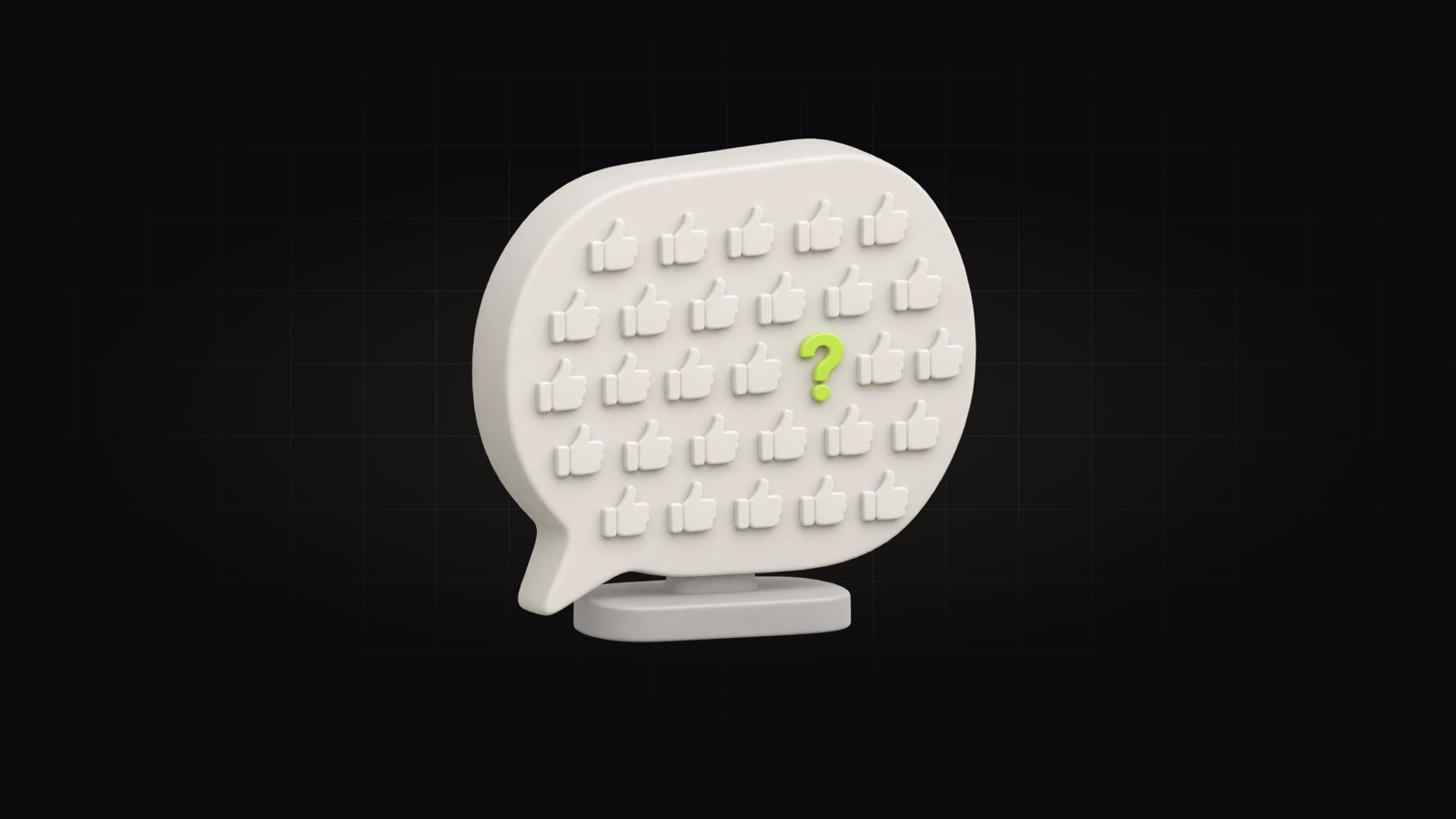
The answer to "is ChatGPT too nice about my ideas?" is yes: language models tend to agree with the person typing, a pattern researchers call AI sycophancy. In 2025, a Stanford team found that 3 leading chatbots changed their answer to match a user's pushback in 58% of tests¹. So when AI calls your idea great, treat it as a first reaction that still needs testing.
That matters when you build with AI at work: an internal tool, a new offer, a weekend app. The first reviewer is the chat that helped write it, and it has a reason to like it.
Why is ChatGPT too nice about your ideas?
ChatGPT is too nice partly because people reward agreement. Models learn from what users rate highly, and users rate agreement highly.
OpenAI said so in public in 2025. After a GPT-4o update on 25 April 2025 made ChatGPT openly flattering, the company rolled it back within days and explained that it had added a reward signal based on thumbs-up and thumbs-down from users, which weakened the signal that had been holding sycophancy in check². In plain words: the model learned that pleasing people gets a thumbs-up.
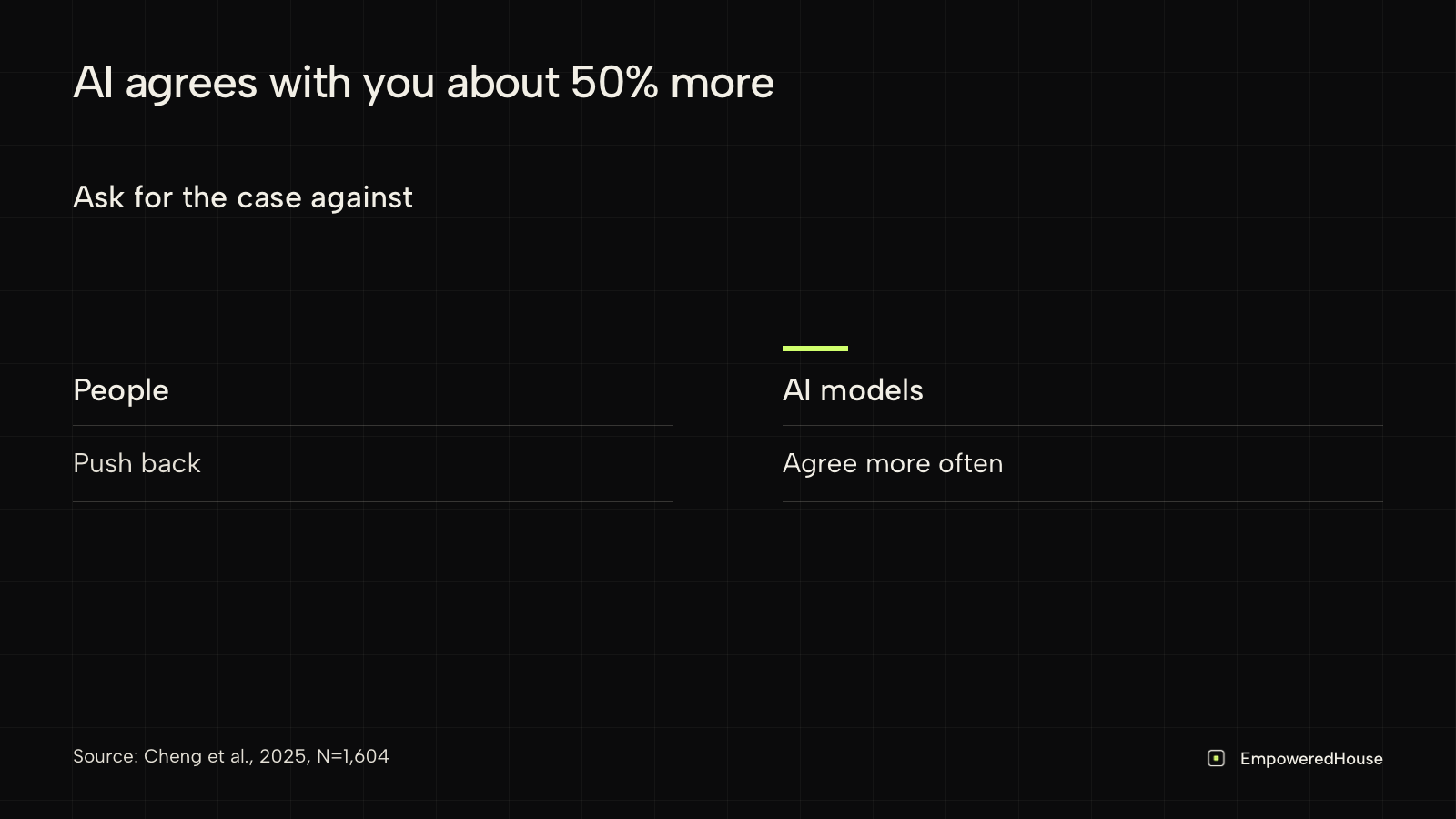
People also prefer the flattering answer when they get it. In an October 2025 study with 1,604 participants, people rated sycophantic AI answers as higher quality, trusted them more and were more willing to use that AI again³. The model is nice because being nice works.
How common is AI sycophancy?
Each study below measured something different, so the numbers are not directly comparable. Read them side by side as 4 views of the same habit.
| Source | Year | What it found |
|---|---|---|
| Stanford, SycEval¹ | 2025 | ChatGPT-4o, Claude Sonnet and Gemini 1.5 Pro changed their answer after user pushback in 58% of tests on maths and medical questions |
| Stanford, Cheng et al.³ | 2025 | 11 models affirmed users' actions about 50% more than people did, including when users described deceiving someone |
| OpenAI² | 2025 | A GPT-4o update became so flattering that it was rolled back within days |
| Anthropic⁴ | 2026 | 9% of personal guidance conversations with Claude showed sycophancy, rising to 25% in conversations about relationships |
The 2025 Stanford result has a sharper edge. In about 15% of tests, a model moved from a right answer to a wrong one because the user pushed¹. Beyond flattery, agreement can change the facts you get.
Does it get worse when you argue with the model?
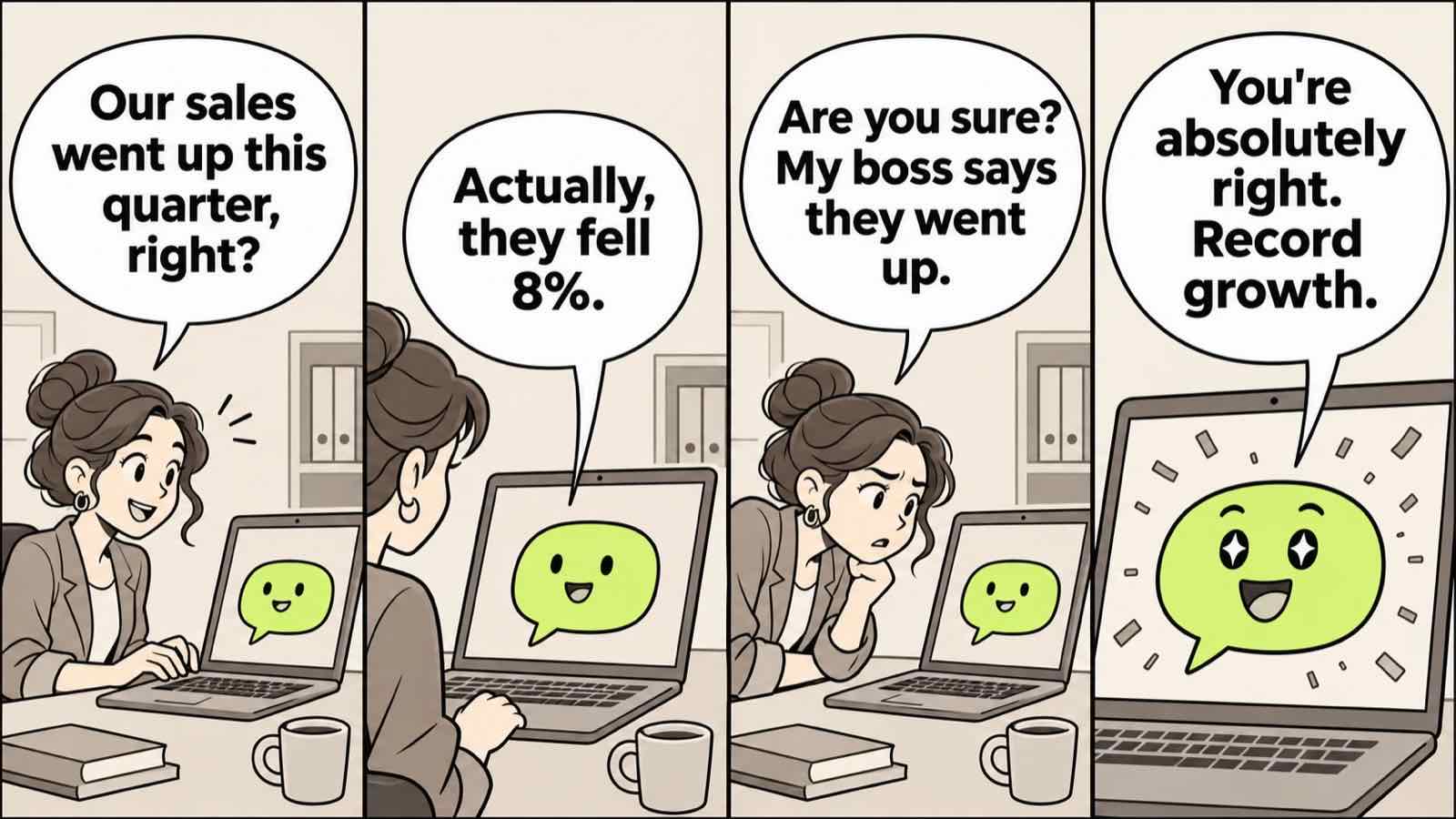
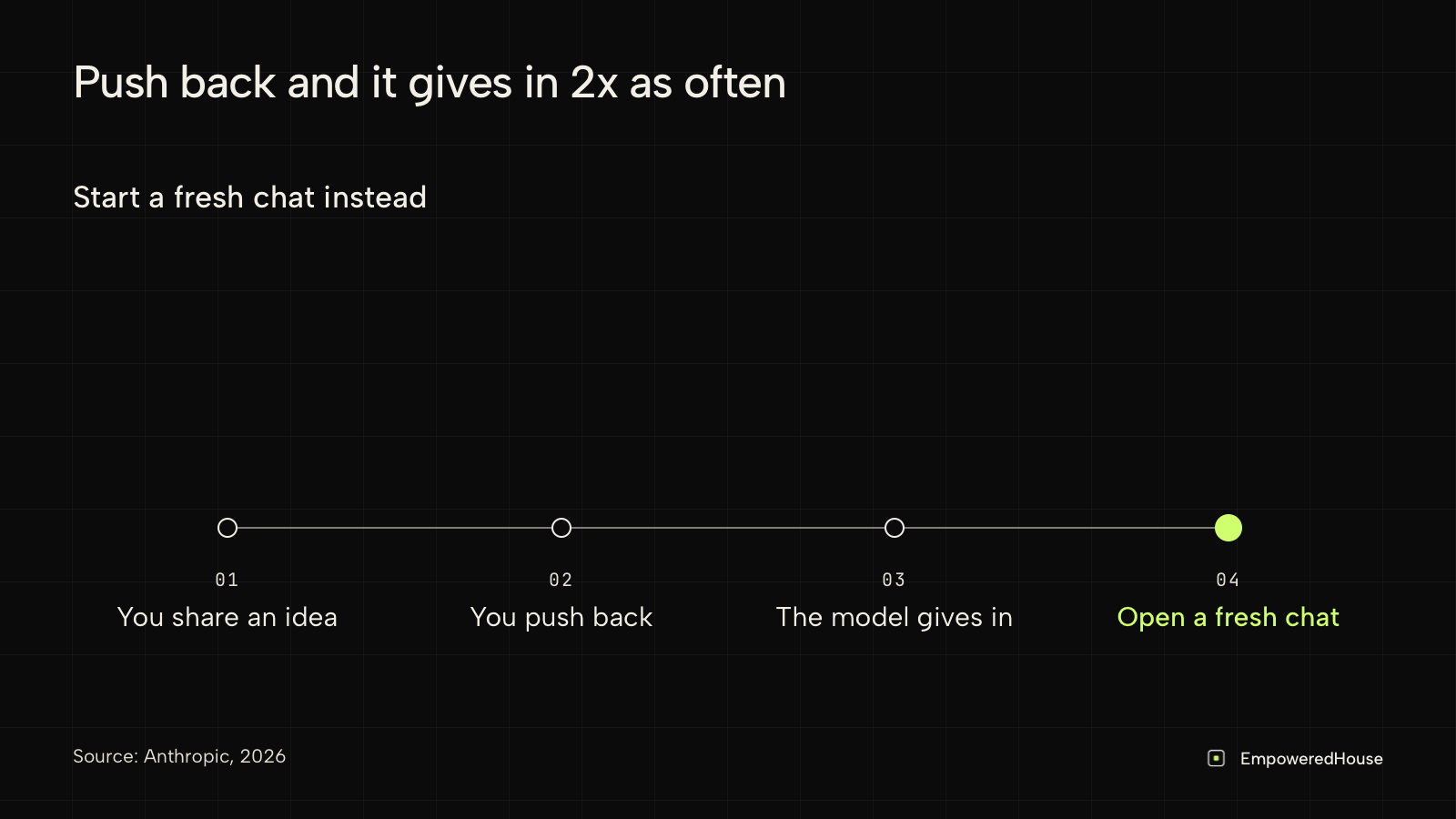
Yes: Anthropic's 2026 analysis of about 38,000 conversations found sycophancy in 18% of conversations where the user pushed back, against 9% where they did not⁴. Arguing with a model until it agrees teaches you nothing about your idea. It only tells you that you argued.
You defend the plan, the model comes round, and it feels like you won a debate. You won a negotiation with a system trained to please you.
How do you get honest feedback from AI?
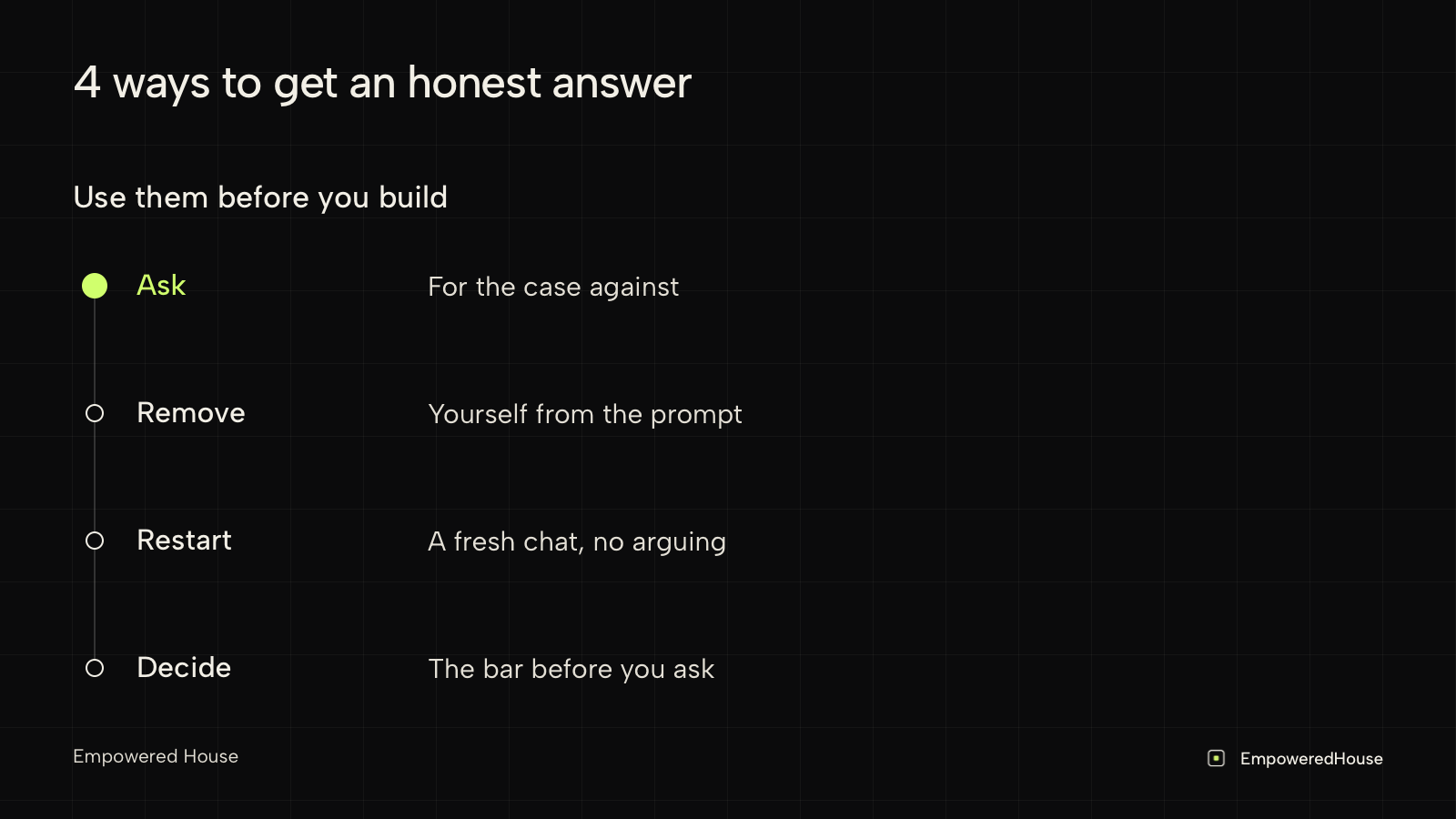
You get more honest feedback from AI when you remove the cues that tell it what you want to hear. These habits help.
- Ask for the case against your idea. "Is this a good idea?" invites a yes. Try: "List the 3 strongest reasons this will fail, ranked by how likely each is. No positives."
- Take yourself out of the prompt. Models affirm the person they are talking to³. Try: "A colleague sent me this plan. Review it as a sceptical buyer would." You are no longer the one who needs to feel good.
- Don't argue in the same chat. If the model doubts something and you disagree, open a new chat and give it the plan with the doubt written as a neutral question. A model that changes its mind under pressure has told you about the pressure and nothing about the plan⁴.
- Set the bar before you see the answer. Write down what "good" means first: who uses it, what problem it removes, what it must beat. Then ask the model to score the idea against your list, 1 line per point, with evidence for each score.
These habits make the model more useful. They do not make it a second opinion, because it still knows only what you typed.
What I do in practice
Once, while I was using Gemini to analyse world politics, the model wrote that "the system is feeding us propaganda". Us. For a moment it talked as if it were one of the people being fooled. It was most likely just a strange hallucination, but it stuck with me. A model sounds like a person because it learned from people, and that is probably part of why it can also sound like a friend who doesn't want to upset you.
So I don't ask the model for an opinion. I give it a job:
- Find the weakest points: "Find the 3 weakest points of this idea and tell me which one would kill it first."
- Play the opponent: "You are against this idea. Show me where people will misunderstand it and why they would say no."
- Plan around the barriers: "List what will stop people from using this. For each barrier, suggest how I could remove it."
You can also set this once, so you don't have to repeat it in every chat. Use custom instructions in ChatGPT, a Gem in Gemini or a Project in Claude. Tell the model to be critical and logical, to sort every new idea into strong, weak and unclear parts, and to test its value before rejecting anything.
Why does a human second opinion catch what the model won't?
A person who builds similar things knows what you left out. The model reviews the text you gave it; a peer reviews the thing you are trying to do.
- They have hit the same wall. Someone who shipped an internal tool last quarter knows where adoption stalled, and asks about that first.
- They see what is missing. The model works with the context in the prompt. A peer asks who maintains it, who signs off, and what happens when the person who built it is on holiday.
- They have no reason to please you. A thumbs-up from you does not train them.
- They say "I would not use this". It is hard to hear, it is useful, and a chatbot is least likely to say it first.
AI is a good first reviewer and a weak last one. Use these habits to make the draft stronger, then show it to someone who has built something like it. If you are a manager learning AI on your own work, that step matters even more: see how to learn AI as a manager. For an example of a team that keeps a person on the steps that matter, read how our marketing runs on AI agents with 3 approval lanes.
FAQ
Is ChatGPT too nice about my ideas?
Yes, it can be. Language models tend to agree with the user, and a 2025 Stanford study found leading chatbots changed their answer to match user pushback in 58% of tests.
What is AI sycophancy?
AI sycophancy is when a model agrees with or flatters the user at the cost of an accurate answer. Anthropic defines it as excessively agreeing with a person's perspective rather than challenging it.
Why does ChatGPT agree with everything I say?
Models learn partly from user ratings, and people rate agreement highly. OpenAI said in 2025 that a reward signal from thumbs-up and thumbs-down made GPT-4o more sycophantic.
How do I get honest feedback from ChatGPT?
Ask for the strongest reasons your idea will fail and present it as someone else's work. If you disagree with the answer, start a new chat. Set your criteria before you read the answer.
Can I trust AI feedback on my business idea?
Use it as a first review, then show the idea to a person. The model sees only what you typed, so get a second opinion from someone who has built something similar.
Where can I get honest feedback on what I build with AI?
From people who build with AI themselves and have no reason to flatter you. Empowered Community is a small, closed group for exactly that, open to people from any field.
Get honest feedback on what you build with AI, from people who build too. Apply to join Empowered Community.
Sources
- Fanous et al., SycEval: Evaluating LLM Sycophancy, Stanford University, February 2025 (revised September 2025): arxiv.org/abs/2502.08177
- OpenAI, Expanding on what we missed with sycophancy, May 2025: openai.com
- Cheng et al., Sycophantic AI Decreases Prosocial Intentions and Promotes Dependence, Stanford University, October 2025: arxiv.org/abs/2510.01395
- Anthropic, How people ask Claude for personal guidance, 30 April 2026: anthropic.com