Human vs AI at work in 2026 is a closer contest than the headlines suggest. AI matched experts on nearly half of real work tasks, but once a person checks and fixes the result, most of the speed gain disappears¹. In Europe the bigger story is simpler: most companies have not started using AI at all³.
In short:
- AI writes the first version fast; a person still checks it and answers for it.
- Most mid-sized European firms do not use AI yet.
- Routine office work changes first; mass job losses have not shown up in the data yet.
- Employers pay for judgement and communication more than for AI tool skills.
- Checking AI output is now one of the human skills AI users rank highest.
Human vs AI at work: who wins on expert tasks?
What it means: on a single task AI can already match an expert, and its work still needs a reviewer.
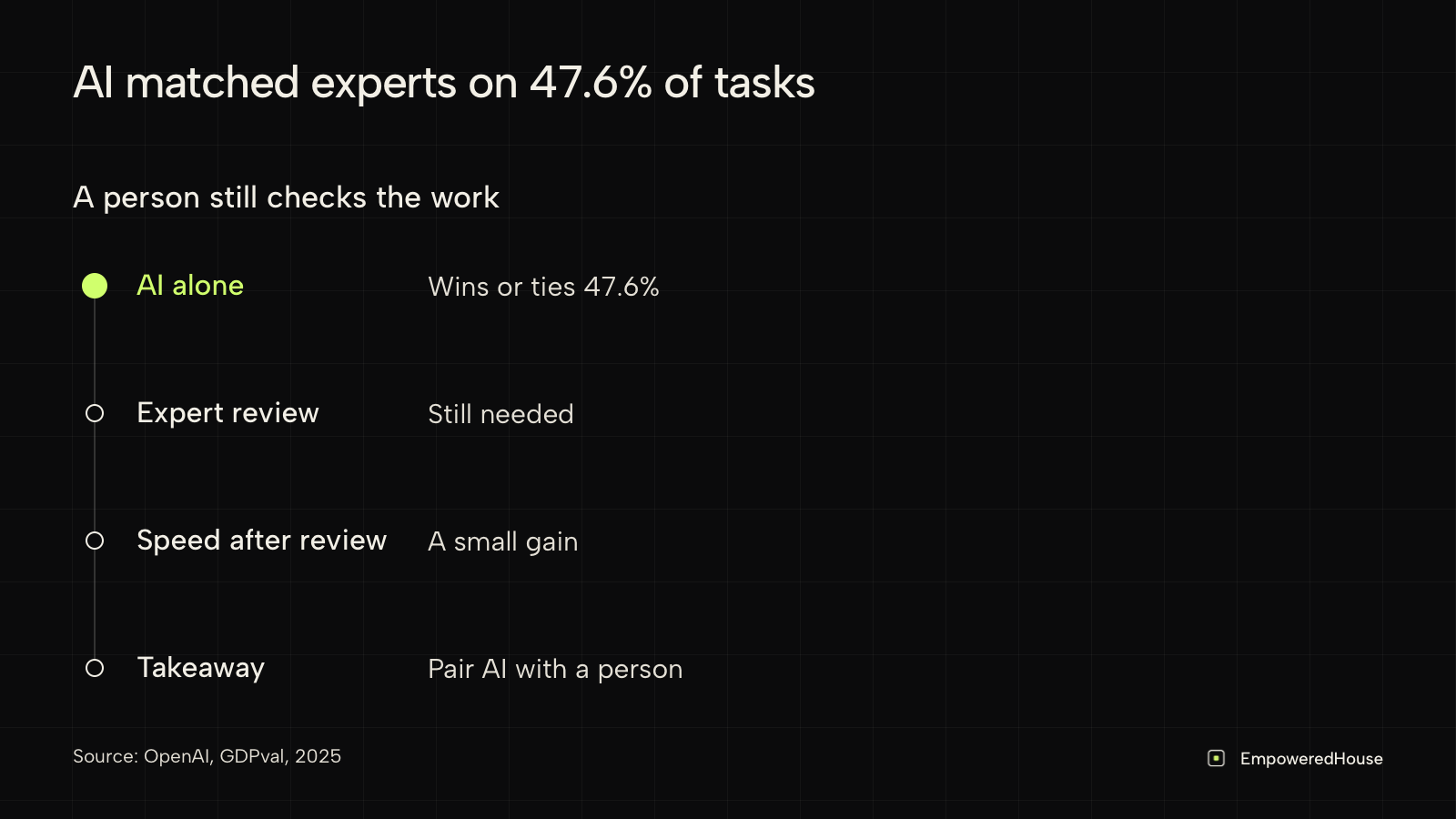
- In OpenAI's GDPval test, experts graded AI and human work on 220 real tasks without knowing which was which¹.
- The best model, Claude Opus 4.1, matched or beat the expert on 47.6% of them¹.
- Unreviewed, GPT-5 was about 90 times faster than the expert. With an expert checking and fixing the result, it was about 1.12 times faster¹.
- AI agents solved 77.3% of real terminal tasks in 2026, up from 20% in 2025, yet they are still weaker at multi-step planning⁷.
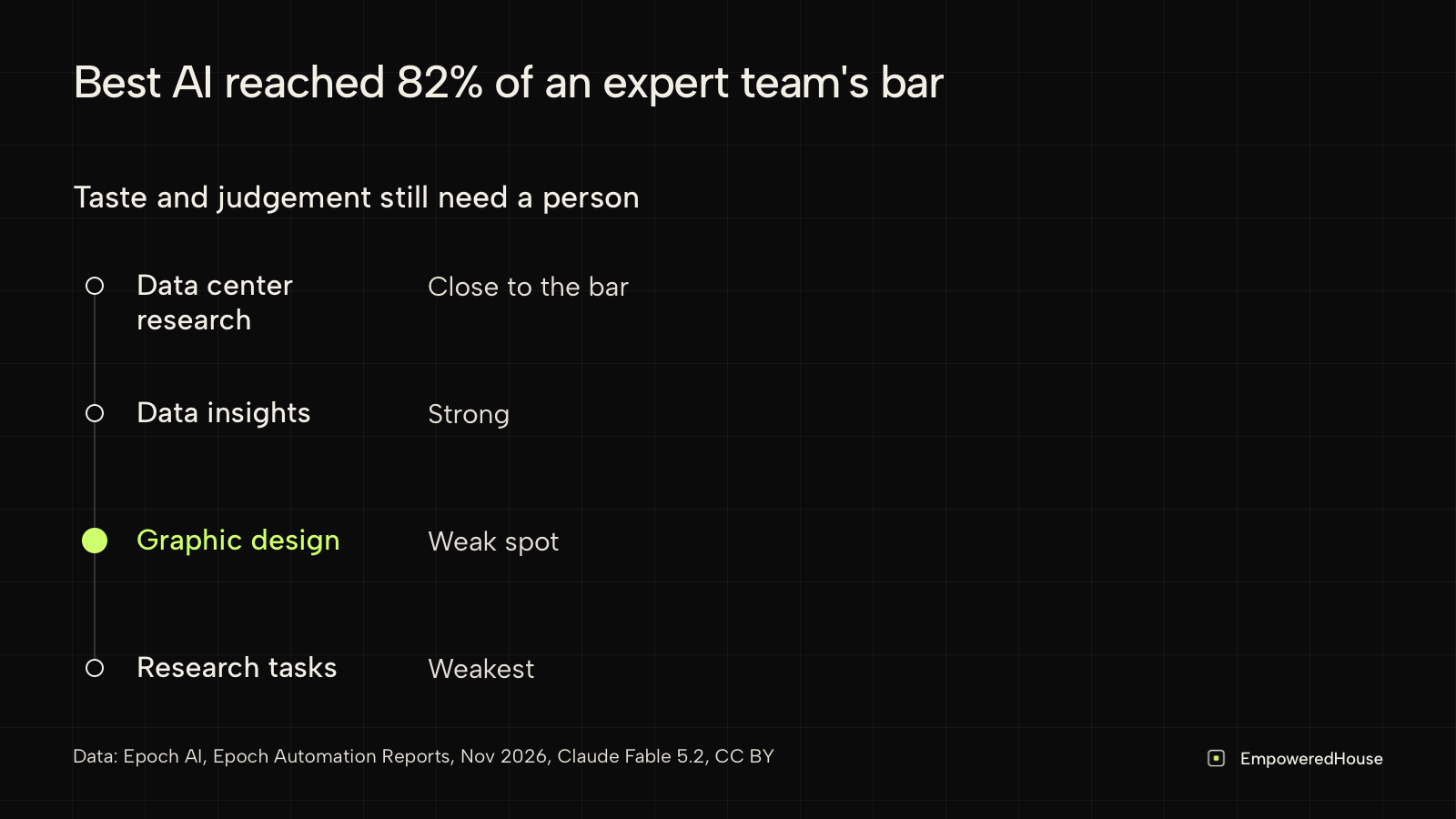
A newer test from November 2026 points the same way. Epoch AI gave AI systems real tasks from its own work and graded the results against the standard it expects from its own people¹⁷.
- The best system, Claude Fable 5.2, reached 82% of that standard on average¹⁷.
- It came close to the bar on data center research (98%), and scored lowest on research tasks (72%) and graphic design (73%)¹⁷.
I see the same split in my own marketing work. On volume, AI is the better brain: it remembers more, processes data faster, pulls information and numbers from our repositories and connects to our tools. It already runs whole processes for me.
How many companies in Europe use AI?
What it means: in most mid-sized European firms, AI is still a plan. The main gap is knowledge.
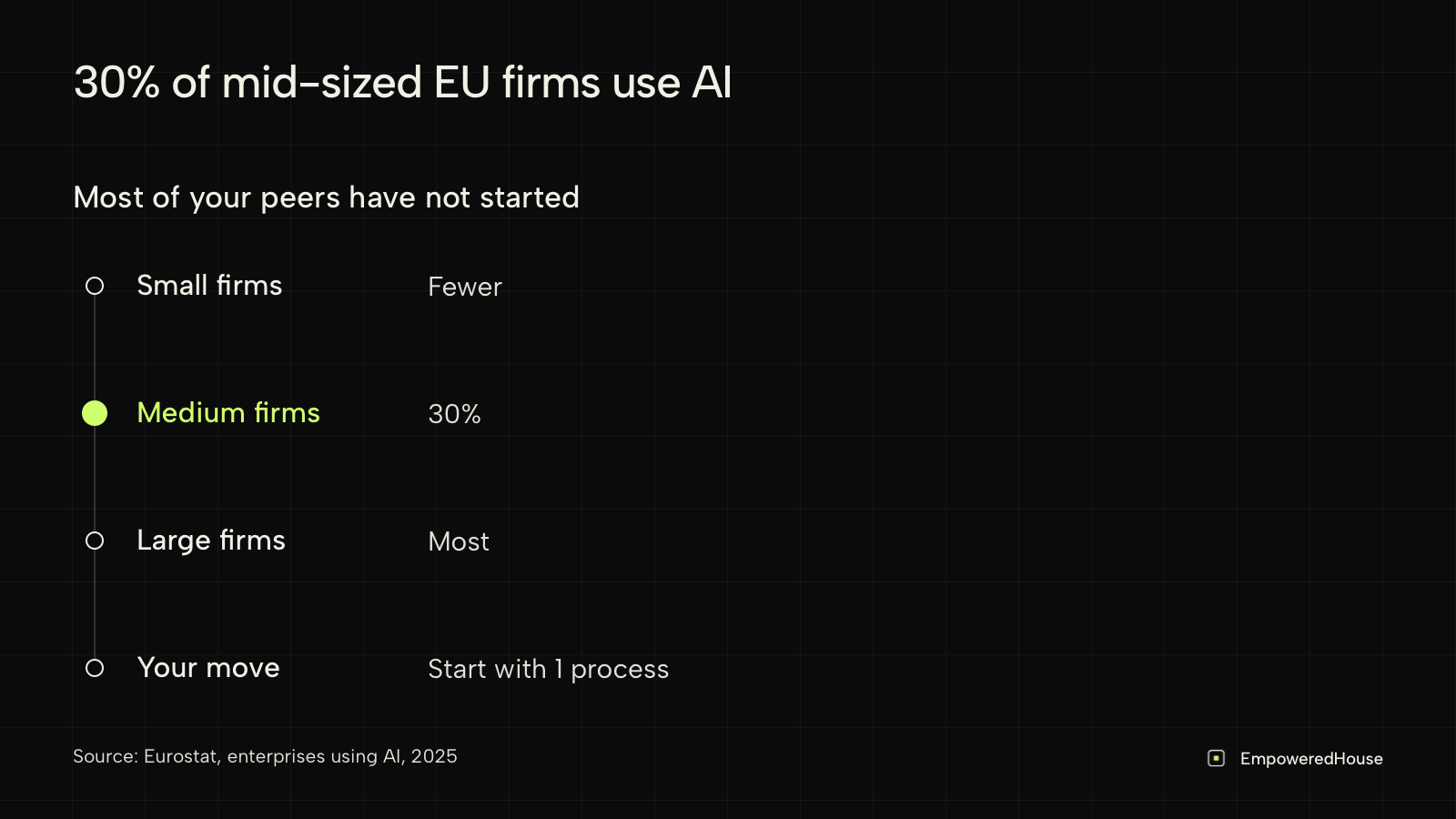
- 20.0% of EU enterprises with 10 or more employees used AI in 2025³.
- In the UK, about 35% of firms with 10 or more employees used AI in June 2026².
- In Poland, 17.8% of enterprises used AI in 2026, double the 8.7% of 2025⁴.
- Among EU firms that considered AI and did not adopt it, 70.9% named lack of expertise as a barrier³.
| Company size (EU, 2025) | Share using AI |
|---|---|
| Small, 10 to 49 people | 17.0% |
| Medium, 50 to 249 people | 30.4% |
| Large, 250 people or more | 55.0% |
Is AI taking jobs in Europe?
What it means: not at scale yet. Employers do expect cuts, and they point at office roles.
- Around half of UK firms that use AI said it had not changed their headcount in June 2026; just under 7% of medium-sized firms reported a fall².
- 17% of UK employers expected AI to reduce their headcount within 12 months (autumn 2025)⁵.
- They named clerical and administrative roles, plus junior managers and professionals, as most at risk⁵.
- By the end of June 2026, a record 9.4% of UK job ads on Indeed mentioned AI, and 48.8% in data and analytics¹².
Which jobs gain and which lose?
What it means: tasks change before job titles do. Routine office work moves first, and work that needs an expert's judgement gains value.
- 25% of global employment is in jobs with some exposure to generative AI, and 34% in high-income countries⁶.
- Clerical occupations have the highest exposure. The index was built with NASK, the Polish national research institute, on Polish task data⁶.
- Women are more exposed than men: 4.7% of women's jobs sit in the highest exposure group, against 2.4% of men's⁶.
- Roles where AI takes the routine and the expert's value rises grew jobs 2 times faster and wages 42% faster in 2026¹⁰.
| Role | What AI takes | What people keep |
|---|---|---|
| Customer service | First written replies at volume | Complaints that need a decision |
| Admin and data entry | Routine entry, forms, summaries | Checking figures against the source |
| Software development | Code drafts | Planning, review, sign-off |
| Finance and analysis | Standard reports, first numbers | Complex analysis and the decision |
| Recruiting and HR | Job ad drafts, first screening | Judgement about people |
| Managers | Meeting and data summaries | Decisions and leading people |
Illustrative summary based on the sources in this article.
Where do people still beat AI?
What it means: people keep the decisions they answer for, and the taste AI still lacks.
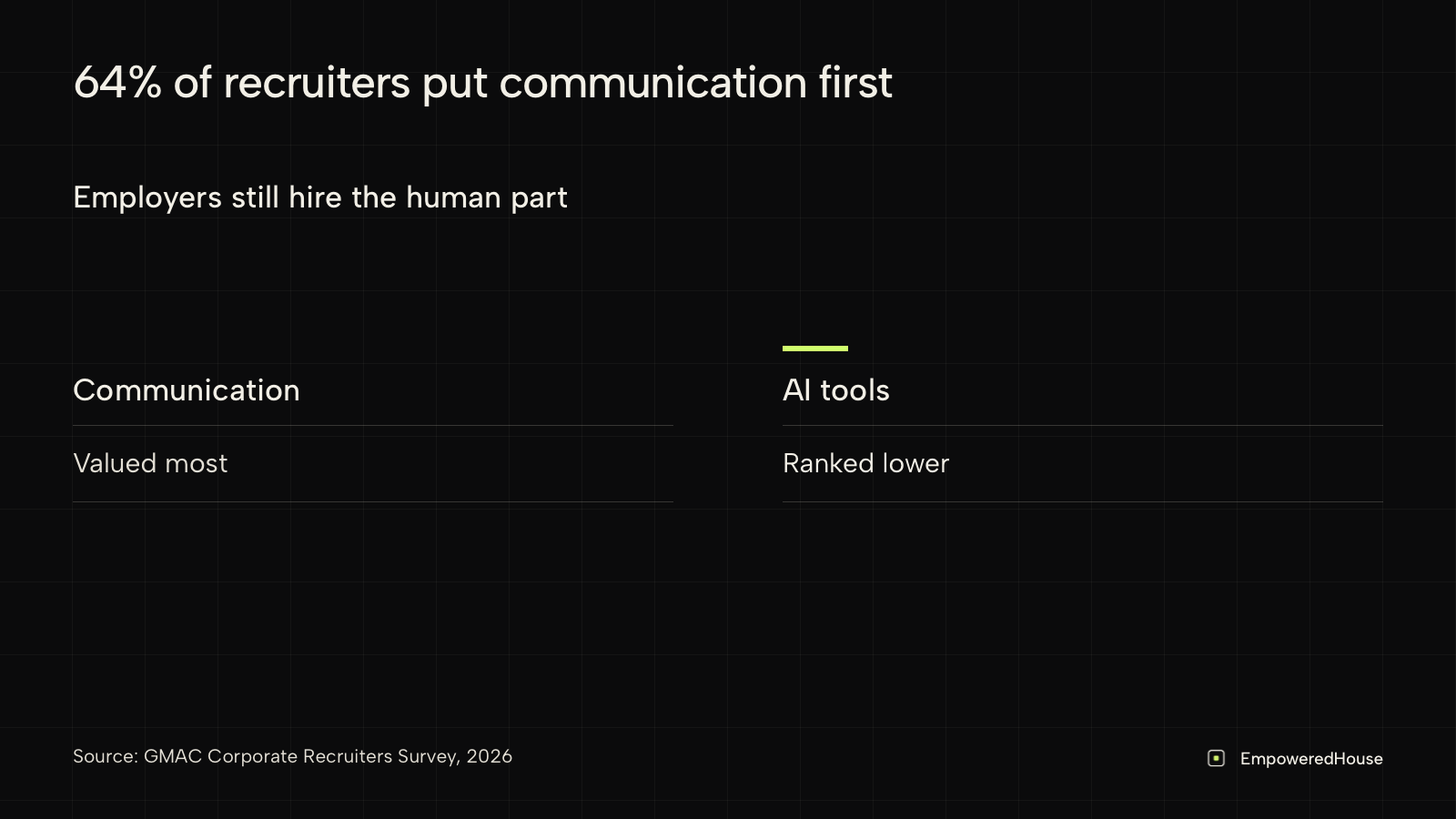
- Communication was the skill employers valued most when hiring in 2026: 64% of recruiters named it¹¹.
- Problem-solving followed at 62% and adaptability at 60%. Skills in using AI tools came 14th, at 50%¹¹.
- In Western Europe, decision-making led at 52%¹¹.
Taste is where AI still loses in my work. Out of the box it is generic, so copy, graphics and video need a lot of manual correction. It learns our rules and still skips one now and then. That is why I like the approach behind EHOS, our platform for building company apps: the rules a team agreed on live in its own app, and AI works inside them.
Where does the human plus AI pair win?
What it means: AI produces, a person checks and answers for the result. Skipping the check leads to mistakes, as the 2025 figures below show.
- 86% of AI users treat AI output as a starting point, in a 2026 survey that included the UK, France, Germany, Italy and the Netherlands⁹.
- The 2 human skills they named most often as more important now: quality control of AI output (50%) and critical thinking (46%)⁹.
- In a 2025 study, 66% of employees who use AI at work had relied on its output without evaluating it, and 56% had made mistakes because of AI⁸.
- Only 13% of AI users said they were rewarded for reinventing their work with AI⁹.
This is how I work every day. I treat AI as an engine and build my own layer on top of it for marketing: rules, CLAUDE.md instruction files and repository conventions. I hand almost nothing over completely and still supervise most of what it does. The one exception is code, which I do not review, because I am not a developer.
If you lead a team, read how to keep teams aligned when AI speeds up work.
What is happening to graduate jobs?
What it means: the first job now expects the judgement and people skills that used to come later in a career.
- UK graduate job postings were about 7% lower in July 2026 than a year earlier, the lowest for that time of year since 2020¹².
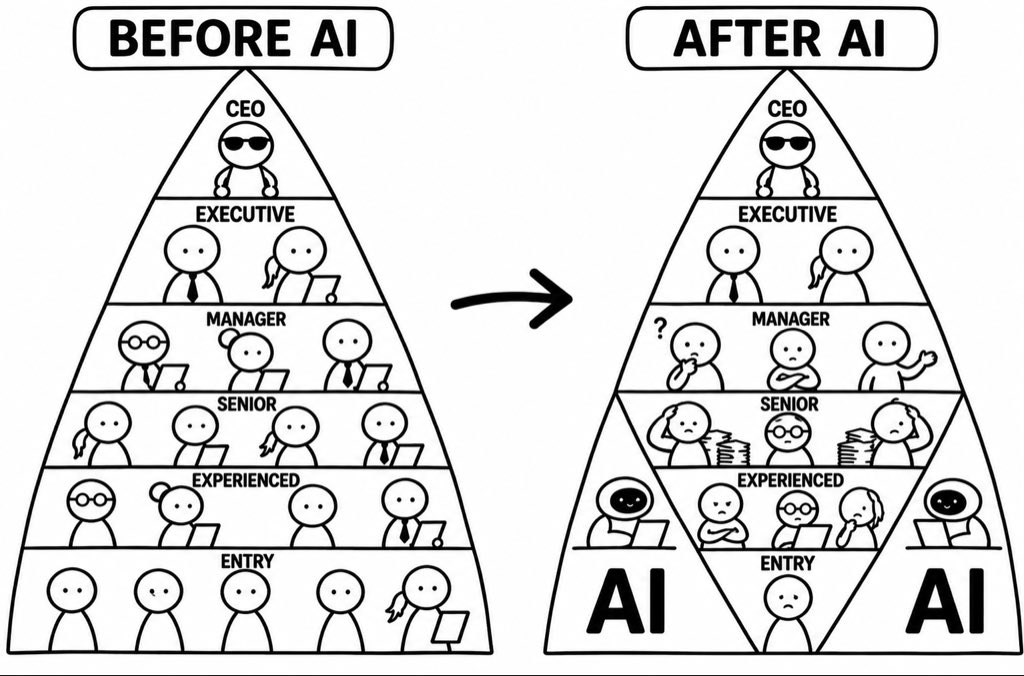
Illustration: Python academia on X, November 2026.
The picture shows the risk at a glance: when AI does the entry-level work, fewer people learn the job from the bottom, and the seniors above them carry more.
What should you do about AI at work in 2026?
- Split your job into tasks. List what you do in a week and mark what AI could draft. For a leader, that list is the map of where to start.
- Let AI write the first draft and own the check. Agree who signs off on AI-assisted work; the same question applies to code, as in who is accountable for AI-generated code.
- Build the skills employers ask for. Practise the skills recruiters rank first on the work you already do.
- Add AI skills that show up in pay. PwC found a 62% wage premium for AI skills in 2026¹⁰.
- Do not learn alone. Learn with peers who build with AI, so you see what works for them. If you lead a team, start with how to learn AI as a manager.
What will change in 2027?
We are at the end of 2026, and the last 9 months changed more than I expected. The release of Claude Opus 4.6 in February 2026 was a loud shift¹³. Today I work with Claude Opus 5.5 and Claude Fable 5.2, and the growth between those versions feels exponential, even brutal. The only answer I see is to learn and adapt very fast.
My forecast for 2027: these tools will keep gaining capabilities. I already use Claude for almost everything, from competitor analysis to research, and it is slowly becoming my window on the world. That is a little sad.
People who build these tools say similar things in their own words:
- Jensen Huang, CEO of Nvidia, in May 2025: "you're going to lose your job to somebody who uses AI", not to AI itself¹⁴.
- Andrej Karpathy, co-founder of OpenAI, in June 2025: we need to "keep AI on the leash", because its output still needs checking¹⁵.
- Dario Amodei, CEO of Anthropic, in May 2025: AI may soon outperform people "at almost all intellectual tasks"¹⁶.
I still believe the human has to stay at the centre of the process. A person cares about quality, and a domain expert spots generic AI output far better than a generalist, because AI by its nature tends to be generic. Right now I see no sign of that changing: each new model has better parameters, and out of the box it still defaults to the generic answer. It is the human who builds the filters and layers on top of AI and shapes it to their own work. In 2026 the human still wins, and I expect the people who build these layers to pull further ahead in 2027 (join other domain experts in Empowered Community).
FAQ
Will AI replace my job in 2026?
No survey can answer that for 1 person. In June 2026, around half of UK firms using AI said it had not changed their headcount², and 17% of UK employers expected AI to reduce it within a year⁵.
What jobs can AI not replace?
No job is safe by title. Work built on decisions someone answers for, trust between people and physical work in changing places is the hardest to automate today⁷.
How many UK businesses use AI?
About 35% of UK firms with 10 or more employees used AI in June 2026².
What percentage of companies use AI in Europe?
20.0% of EU enterprises used AI in 2025: 17.0% of small, 30.4% of medium and 55.0% of large firms³.
Is AI reducing entry-level jobs?
In the UK, graduate job postings were about 7% lower in July 2026 than a year earlier¹².
What skills do employers want in 2026?
Communication, problem-solving and adaptability: 64%, 62% and 60% of recruiters valued them when hiring in 2026¹¹.
Work with people who build with AI too: a small, closed group that gives direct feedback on what you build. Apply to Empowered Community.
Written by Piotr, who runs marketing at Empowered House with AI agents; more about us.
Sources
- OpenAI, GDPval: Evaluating AI Model Performance on Real-World Economically Valuable Tasks, October 2025: arxiv.org
- Office for National Statistics, Artificial intelligence in UK businesses: 2023 to 2026, 20 July 2026 (BICS wave of 5 to 28 June 2026, 38,637 firms): ons.gov.uk
- Eurostat, Use of artificial intelligence in enterprises, 2025 data (isoc_eb_ai), news of 11 December 2025: ec.europa.eu
- GUS, Information society in Poland in 2026, press release of 29 October 2026: stat.gov.pl
- CIPD, Labour Market Outlook, autumn 2025 (2,019 HR professionals and decision-makers, YouGov): cipd.org
- International Labour Organization, Working Paper 140, Generative AI and Jobs: A Refined Global Index of Occupational Exposure, May 2025: ilo.org
- Stanford HAI, AI Index Report 2026, April 2026: hai.stanford.edu
- KPMG and University of Melbourne, Trust, attitudes and use of AI: A global study 2025: kpmg.com
- Microsoft, 2026 Work Trend Index, May 2026: microsoft.com
- PwC, 2026 Global AI Jobs Barometer, June 2026: pwc.com
- Graduate Management Admission Council (GMAC), Corporate Recruiters Survey 2026 Report (621 recruiters and hiring managers, 39 countries, January to May 2026): gmac.com
- Indeed Hiring Lab, 2026 Mid-Year UK Jobs and Hiring Trends Report, August 2026: hiringlab.indeed.com
- Anthropic, Claude Opus 4.6 release, 5 February 2026: pureai.com
- CNBC via NBC Los Angeles, Nvidia CEO: You won't lose your job to AI, May 2025 (Milken Institute Global Conference): nbclosangeles.com
- Business Insider, Keep AI on the leash, says Andrej Karpathy, June 2025 (YC AI Startup School): businessinsider.nl
- CNN, Takeaways from Anthropic CEO Dario Amodei's interview, 29 May 2025: wral.com
- Epoch AI, Epoch Automation Reports, 17 November 2026, data under CC BY: epoch.ai
The figures come from different surveys, years and samples. Read them as a direction of travel, not as a ranking of countries.