What problem does Empowered Intelligence solve?
3 moments a leader in a company of 50 to 300 people knows well:
- A decision is made, and nobody knows whether it is taking hold. A new minimum margin, a new step in planning, a 2-day deadline. You ask a question about a decision once; every night new evidence from meetings, documents and CRM notes is added for or against it.
- Numbers go wrong quietly, and nobody watches all of them. With Health you pick areas, give each an owner and the numbers that say it is fine; every morning they are checked, and the owner gets an email only when something new goes wrong.
- Status reports stay green until someone opens the numbers. Answers show the source record behind them, so a review starts from evidence, not from how a status was reported.
Glean vs Empowered Intelligence: how do the 2 jobs compare?
| Criterion |
Glean |
Empowered Intelligence |
| Main job |
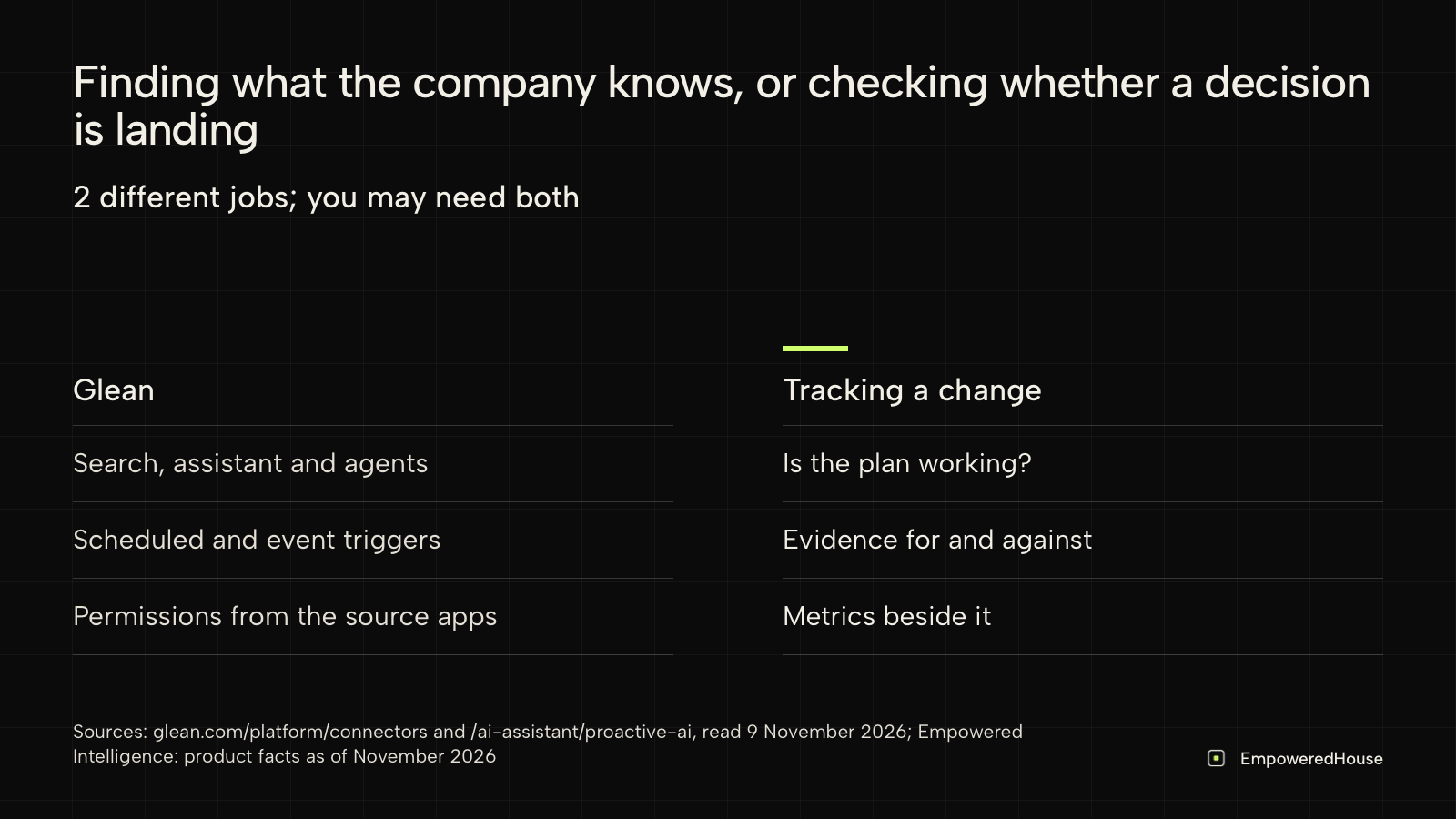
Enterprise search, assistant, agents and actions across connected apps¹ |
Tracking whether a planned change lands, with evidence and, when your data is connected, metrics |
| Recurring work |
Agents can run on a schedule or when something happens; a weekly check of 1 decision has to be set up and tested¹ |
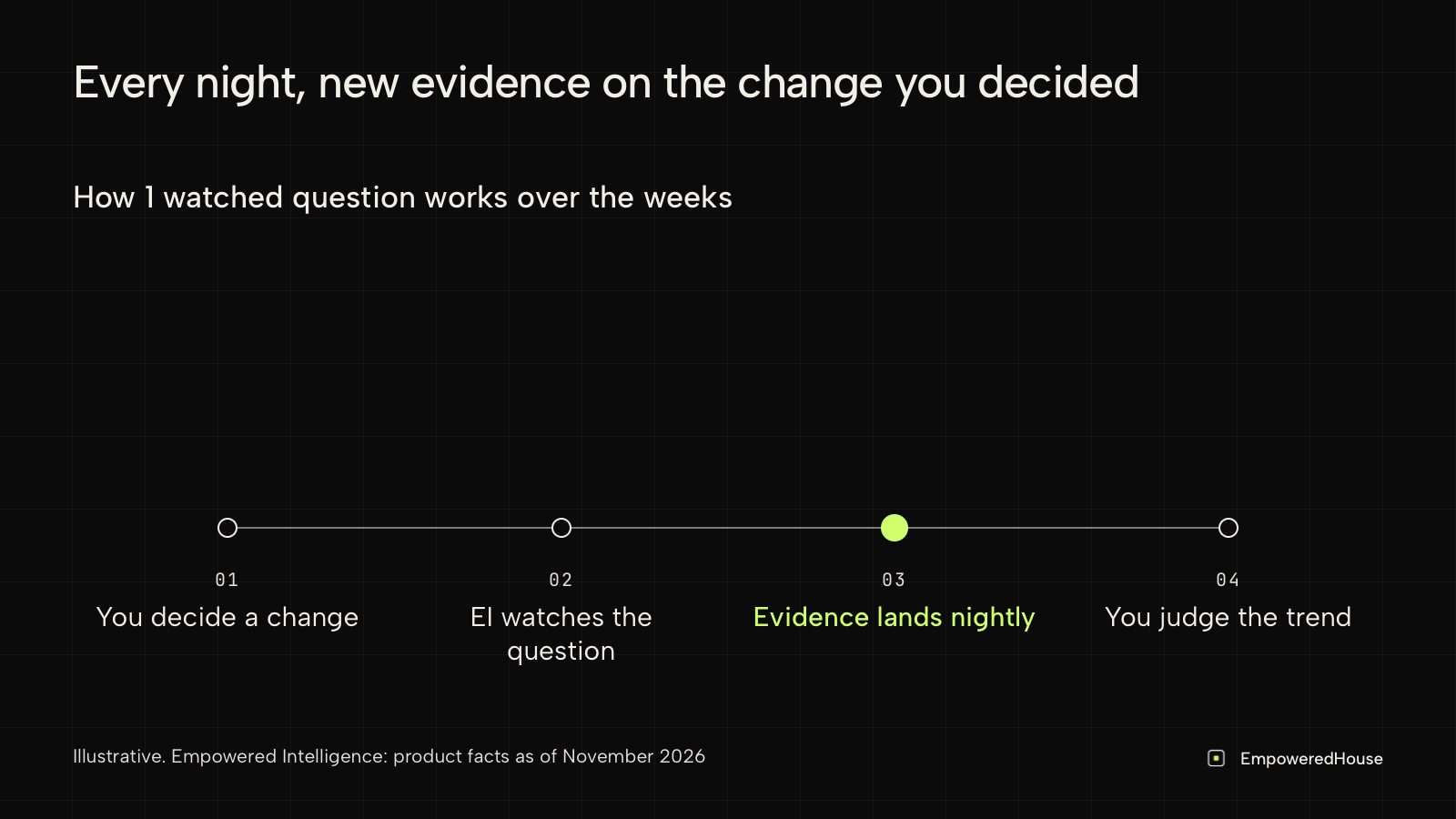
Questions to watch stay open over weeks, with new evidence for, against or neutral |
| Proactive monitoring |
Independent agents (beta) monitor issues and carry out next steps² |
A person opens and closes each watched question and judges the result |
| Connectors |
More than 275, set up out of the box¹ |
6 tools live, plus Excel or CSV files your team sends, which we connect for you |
| Access to data |
Permissions inherited from source apps and enforced¹ |
Read-only connections |
| Public price |
Not published; the pricing address redirects to the home page³ |
Not published; scoped after a workshop |
| How to start |
A form, then a time slot, then the demo⁴ |
A conversation, then a workshop |
Facts checked against vendor documentation on 2026-11-12.
Already using Glean and 1 decision still goes unchecked? Name it, and in the first conversation we map which of your records and which metric would show whether it lands. Describe your decision.
What does Glean do today?
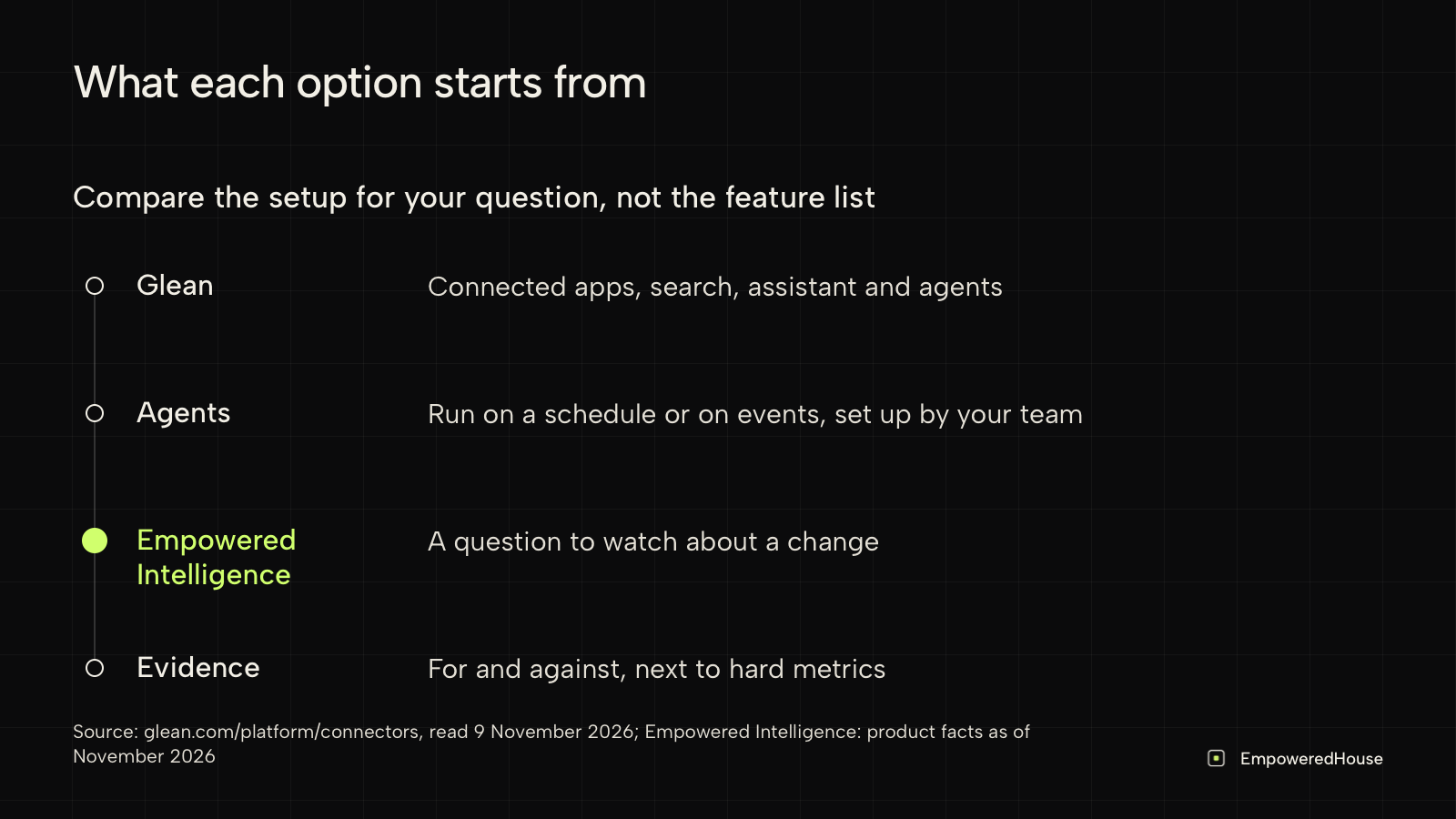
Glean describes itself as a way to "ground AI in company context"¹. Its public pages, read on 2026-11-12, cover 4 layers:
- Enterprise search and an assistant. More than 275 connectors set up out of the box, with real-time data sync as content changes in the source app¹.
- Permissions. Glean states that data permissions are inherited from the connected apps and strictly enforced, so people see only what they are allowed to see¹.
- Agents and Actions. Glean says you can trigger agents based on events or schedules and have them take action, with human-in-the-loop controls that can require approval before execution¹.
- Proactive AI. Glean surfaces updates, blockers and decisions relevant to each person. Its independent agents, marked beta, monitor issues, investigate them and carry out next steps².
If your team needs scheduled or event-driven work across the apps it already uses, those capabilities belong in your evaluation.
Search versus proof of adoption: the interview scorecard example
Your company of 120 people introduces a new interview scorecard. Every hiring manager should use it in every round, and you expect time-to-hire to drop.
Question 1: where is the scorecard? A recruiter wants the latest version and the guidance that goes with it. This is finding a document, the job enterprise search is built for.
Question 2: is the scorecard being used, and is it working? 6 weeks later, the head of people wants to know whether every hiring round used it, which teams skipped it and whether time-to-hire moved. This needs an agreed definition of "used", records from the hiring process, an owner and a review that repeats every week.
Search and agents can help with the second question. The question is how much work it takes to get that answer every week.
In 2026, 87% of knowledge workers said that with everyone busy executing, they often lack the time or capacity to coordinate⁵. When there is no analyst to run that weekly review, it falls to the leader who made the decision.
What does a decision-review workflow need to define?
The scorecard review only works when 5 things are written down:
- The owner. 1 person opens the question, reads the evidence and closes it.
- What counts as adoption. For example, a completed scorecard in every final-round interview.
- The records. Interview notes, hiring documents and meeting notes that show whether the rule was followed.
- The metric. Time-to-hire, read from the company's own data, next to the evidence.
- The review rhythm. The same question, answered again every week with new evidence.
For a mid-sized team, assigning a data specialist to 1 monitoring use case like this can cost more than it returns.
How does Empowered Intelligence handle the same question?
Empowered Intelligence, built by Empowered House, is for companies of 50 to 300 people without a dedicated BI or IT team. The setup is run by the Empowered House team, starting with a workshop.
It sets up questions to watch and can propose them itself, for example "Are hiring managers using the new interview scorecard?" A person opens and closes each question and judges the result. Each question is linked to claims taken from your records, such as meeting notes and documents. When your company's data is connected, hard metrics such as time-to-hire sit next to the claims. New evidence is sorted as for, against or neutral every night. Every connection is read-only.
Live today, it reads 6 tools: Roam, Google Meet, Notion, Airtable, Attio and Recruitee, plus Excel or CSV files you send, which we connect for you. Empowered Intelligence does not check whether the data in your CRM or ERP is correct, so a finding is only as good as the records behind it. For a full walk-through, read What is Empowered Intelligence?. For the wider problem of teams drifting apart, see how to keep teams aligned when AI speeds up the work.
Do you need a Glean alternative, an add-on or both?
Choose Glean when finding information across separate apps is the main cost, or when you want 1 search and assistant that follows each tool's permissions¹ and agents on schedules and events across a wide set of connectors¹.
Consider Empowered Intelligence when the open question is whether a decision is being carried out, and you want a person-owned question, evidence for and against, and a metric in 1 view, set up by a team rather than built in-house.
Use both when search covers knowledge and you still need a weekly review of 1 or 2 changes. Search finds the scorecard; the review shows whether it is used.
FAQ
Is Empowered Intelligence a replacement for Glean?
No. If enterprise search is your main need, compare enterprise search products. Empowered Intelligence fits when you need to know whether a decision is being carried out, who owns it and what the numbers say.
Can Glean agents run on a schedule?
Yes. Glean's connectors page says agents can be triggered by events or schedules and take action, with optional approval before execution¹.
Does Glean have proactive AI?
Yes. Glean's Proactive AI surfaces updates and blockers for each person, and its independent agents, marked beta on 2026-11-12, monitor issues and carry out next steps².
Does Glean publish its prices?
No. On 2026-11-12 the pricing address redirected to the home page³, and the next step offered is a demo request⁴.
How do you measure adoption of a new interview scorecard?
Define adoption, for example a completed scorecard in every final round, track the share of rounds that meet it, and read it next to time-to-hire every week with 1 owner.
Can you use Glean and Empowered Intelligence together?
Yes, side by side. They do different jobs: Glean finds and acts on company knowledge, Empowered Intelligence follows whether a planned change lands.
If you are looking at Glean because a rollout like a new scorecard keeps stalling, bring that 1 use case and the tools it touches. Together we check whether your current sources can track it. Review 1 use case with us.
Sources
- Glean, Connectors, read 2026-11-12: glean.com/platform/connectors
- Glean, Proactive AI, read 2026-11-12: glean.com/ai-assistant/proactive-ai
- Glean, Pricing (redirects to the home page), read 2026-11-12: glean.com/pricing
- Glean, Get a demo, read 2026-11-12: glean.com/get-a-demo
- Atlassian, State of Teams 2026, 12,035 knowledge workers in 6 countries, read 2026-11-05: atlassianblog.wpengine.com